

Is This a True Step Forward for Women – or a New Danger Disguised as a Right by the Alcohol Industry?
July 25, 2025
Media Release – 2025.08.13 – Sinhala
August 14, 2025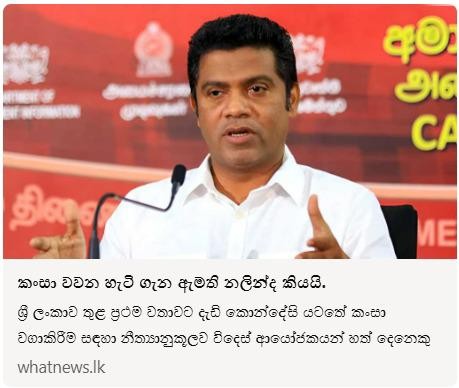
Reference: කංසා වවන හැටි ගැන ඇමති නලින්ද කියයි. https://whatnews.lk/2025/08/12/minister-nalinda-also-talks-about-how-to-grow-hemp/
At a press conference held on 12 August 2025, Minister Nalinda Jayatissa announced that permission has been granted for seven foreign investors in cannabis cultivation under the Board of Investment (BOI), with security provisions in place. According to the Minister, the stated aim of these projects is to utilise all parts of the cannabis plant exclusively for export, in order to generate economic benefits for Sri Lanka.
It should be recalled that a similar proposal was previously halted in Sri Lanka following strong opposition from the Sri Lanka Medical Association, the Sri Lanka College of Psychiatrists, the College of Community Physicians, the Alcohol and Drug Information Centre (ADIC), and the wider community. It is deeply concerning that the current government is now taking steps to implement the same proposal brought forward by the previous administration.
We note with regret that the current Deputy Minister of Investment Promotion, who once publicly opposed and criticized this proposal on social media during his time in the opposition, has now taken steps to implement it in his new role as Deputy Minister at the BOI.
Despite repeated efforts worldwide to legalise cannabis, such moves have largely failed due to strong public resistance and the opposition of scientific and medical experts. In recent years, however, the global cannabis industry, supported by influential figures such as George Soros, has sought to reframe cannabis as a purely economic product—one capable of generating export income. By introducing the idea of ‘controlled cultivation for export,’ they aim to normalise and expand legal production as part of a long-term strategy to achieve full legalisation. It is unfortunate that the new government appears to have aligned itself with this global agenda.
The reality is that the international cannabis market is in decline, caused by oversupply, falling demand, overproduction, and market saturation. Many of the world’s largest multinational cannabis companies have been reporting losses amounting to billions of dollars for several consecutive years.
Against this backdrop, it is troubling that the government is making decisions of such national importance without thorough consideration of the economic realities. This is especially surprising given that the present administration has been highly critical of many initiatives undertaken by previous governments—yet now appears to be adopting this proposal in haste, raising serious questions about its motives.
We therefore urge the authorities to address the following key concerns:
- Given that alcohol, tobacco, and other illicit drugs are already accessible in Sri Lanka despite legal restrictions, what guarantees can be offered that cannabis cultivation will remain confined to so-called “safe” and controlled zones?
- Has an independent, credible international market study been conducted to assess market size, prices, profitability, and the actual foreign exchange benefits to Sri Lanka?
- Has the government evaluated whether Sri Lanka can realistically compete with major legal cannabis producers such as China and the Netherlands?
- Has the impact of the existing global illicit cannabis market—which produces millions of tons annually—been factored in, especially in terms of competing with legal exports from a small nation like Sri Lanka?
- Will multinational cannabis corporations be permitted to operate in Sri Lanka, either independently, in partnership with local entities, or through joint ventures with the government?
- Have alternative high-value cash crops—such as castor, medicinal beans, or citrus—been considered as more viable economic options?
- Which countries have successfully resolved foreign exchange crises through cannabis cultivation?
- Has the government considered the extensive investments made by the tobacco industry into cannabis companies, despite the fact that those companies have suffered significant financial losses?
In conclusion, we highlight that this decision poses serious risks to the health, economy, and security of the nation, and will only push Sri Lanka further into crisis.
As a government claiming to act in the people’s interest, we call on the authorities to immediately reverse this decision.