

“Abhisheka” Promotions through common restaurants in Padeniya, Kurunegala
July 22, 2025
The Hidden Agenda of the Cannabis Industry and its Risks
August 14, 2025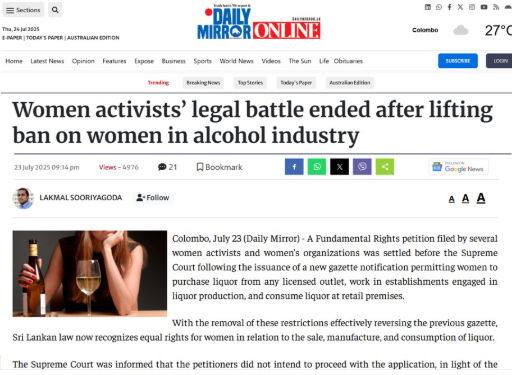 On 23rd July 2025, The Daily Mirror reported a landmark legal development under the headline: “Women activists’ legal battle ended after lifting ban on women in alcohol industry.” The article, written by Lakmal Sooriyagoda, detailed how a group of women activists and organizations withdrew their long-standing Fundamental Rights petition “following a new gazette notification” issued by the government. This regulation officially lifted the restrictions placed on women in relation to Sri Lanka’s alcohol industry.
Under the revised policy, women are now legally allowed to:
- Purchase liquor at any licensed outlet
- Work in the production, sale, and distribution of alcohol
- Consume alcohol at retail premises
This legal shift effectively grants equal rights to women in the context of alcohol-related activities, overturning discriminatory provisions that had been in place for decades. The Supreme Court, having been notified of the policy change, dismissed the original petition filed in 2018 by groups such as the Women & Media Collective, CENWOR, and individuals like Professor Camena Guneratne. The petition had challenged Gazette No. 04/2018, which restricted women from working in or purchasing alcohol at taverns, citing it as a violation of constitutional rights under Articles 12(1), 12(2), and 14(1)(g).
🟢 The Victory for Equality — and the Questions It Raises
While this development is seen by some as a victory for gender equality, it also raises serious social, health, and cultural concerns that deserve critical reflection.
🔍 Key Concerns About the Impact
- Health Risks
Alcohol is a well-known risk factor for many non-communicable diseases. Of particular concern:
- It significantly increases the risk of various cancers, especially breast cancer, which is already the most common cancer among Sri Lankan women.
- It contributes to liver disease, mental health disorders, and addiction, all of which can have lasting impacts on individuals and families.
- Threat to Families and Social Harmony
- Alcohol use is a major contributor to domestic violence, family disputes, and the breakdown of household stability.
- Women, who traditionally serve as protectors of family wellbeing, may now face increased exposure to the negative pressures of alcohol culture.
- Cultural and Moral Impact
- Sri Lankan society has long upheld values that discourage alcohol use by both men and women. Many women themselves oppose alcohol consumption—particularly among men—because of its damaging effect on families and community life.
- Increasing alcohol access for women may erode traditional and moral values, especially as female alcohol consumption, currently low, begins to rise.
- Risk of Commercial Exploitation
- The alcohol industry may use this legal change to promote and market alcohol more aggressively, potentially using women in advertisements and promotional content.
- What appears as a victory for women’s rights may, in practice, benefit industry profits more than empower women.
- Freedom vs. Responsibility
- Legal access does not automatically translate to true empowerment. Empowerment must come with informed, responsible choices that protect health, dignity, and social wellbeing.
- Expanding alcohol availability without addressing women’s real challenges, such as violence, inequality, and economic vulnerability, could lead to long-term harm.
🧭 Final Thoughts
This legal change has “corrected a discriminatory law”, but it also opens the door to new and complex challenges — social, economic, cultural, and health-related. While equality under the law is essential, it must be balanced with policies that protect the wellbeing of women and society at large.
In a country already grappling with alcohol-related problems, expanding access to alcohol may do more harm than good if not paired with strong public health protections, awareness campaigns, and ethical regulation.
The question remains:
Is this a genuine step forward for women, or a new danger cleverly disguised as a right — benefiting the alcohol industry more than society?
Author Note:
Amaranath Tenna is a long-standing advocate in alcohol and drug prevention and currently serves as Programme Director at ADIC Sri Lanka.
Read more about the issue:
The Women And Alcohol In Sri Lanka: A Tale Of Feminism And Politics: https://movendi.ngo/blog/2018/01/29/the-women-and-alcohol-in-sri-lanka-a-tale-of-feminism-and-politics/
Female activists petition Supreme Court challenging archaic liquor laws against women: https://sundaytimes.lk/online/news-online/female-activists-petition-supreme-court-challenging-archaic-liquor-laws-against-women/2-1038043


